

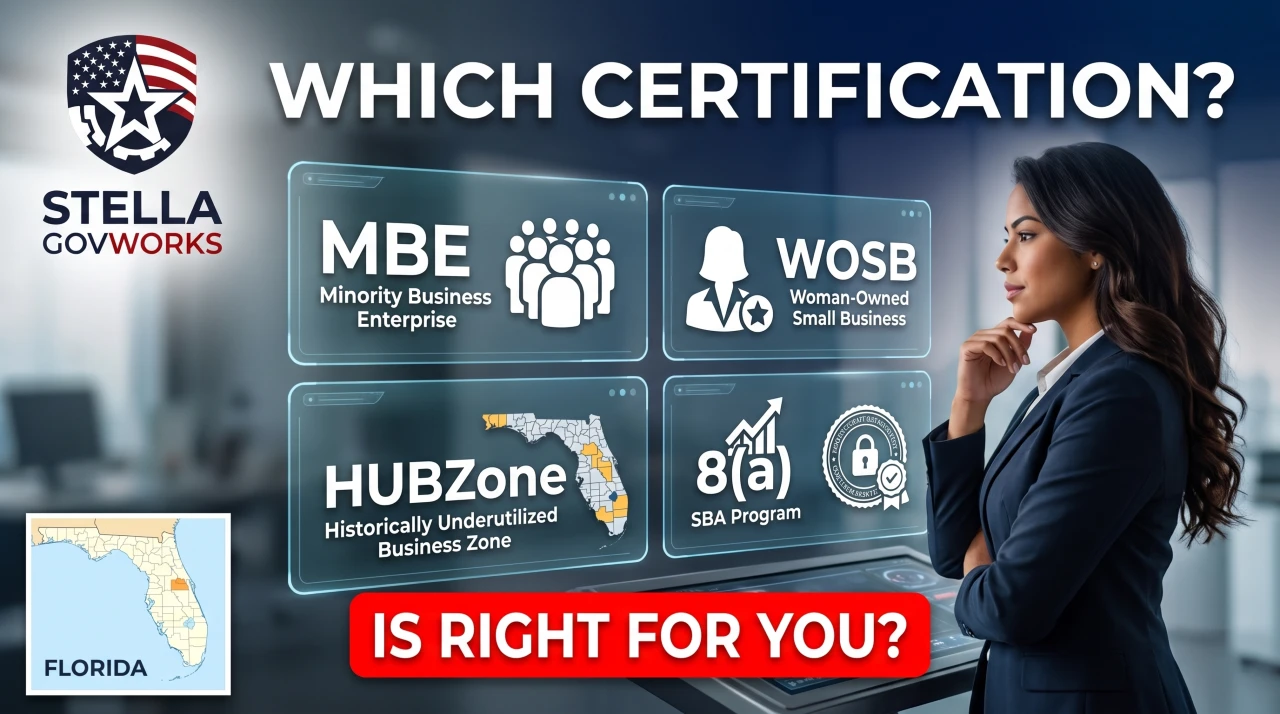
When a small business starts exploring government contracting, one of the first hurdles is realizing there are several supplier diversity certifications, and each one serves a different purpose. It isn’t that one is stronger than another: the right question isn’t which certification is the strongest, but which certification actually matches your company’s real structure. This article covers the four most relevant ones for a small business in Florida: MBE, WOSB, HUBZone, and 8(a).
Why so many different certifications exist
The federal government has a goal of directing at least 23% of contract dollars to small businesses, with specific sub-goals within that percentage: 5% to socially and economically disadvantaged small businesses (which includes 8(a)), 5% to woman-owned businesses (WOSB), 3% to HUBZone, and 3% to service-disabled veteran-owned small businesses (SDVOSB). Each certification exists to verify that a company genuinely belongs to one of these categories, granting access to the portion of contracts set aside for that group.
MBE (Minority Business Enterprise)
This applies if your business is at least 51% owned, operated, and controlled by a person from a minority group: Hispanic, African American, Asian American, or Native American. Unlike the other three, it isn’t strictly a federal certification: it’s mostly processed through organizations such as the National Minority Supplier Development Council (NMSDC) or state and local programs.
Where MBE certification has the most impact
Its greatest strength is opening doors in both public procurement at the state and local level and in supplier diversity programs run by large private companies (Fortune 500 and similar), which actively seek certified suppliers to meet their own internal supply-chain diversity goals. This makes it especially useful for professional services firms that want to sell to both government and the corporate sector.
WOSB and EDWOSB (Women-Owned Small Business)
This is for businesses where one or more U.S. citizen women own and control at least 51%. It provides access to federal contracts specifically set aside for this type of business. The EDWOSB (Economically Disadvantaged WOSB) version adds an additional requirement: the owners must demonstrate economic disadvantage under SBA criteria.
The change many people still don’t know about: self-certification no longer exists
Since October 2020, the SBA eliminated the ability to self-certify as a WOSB. Today, businesses must go through the SBA directly or through an approved third-party certifier, such as the Women’s Business Enterprise National Council (WBENC) or the US Women’s Chamber of Commerce. This is one of the points that confuses businesses the most, especially those that researched the process a few years ago and assume the old procedure still applies.
HUBZone (Historically Underutilized Business Zone)
Unlike the others, this certification doesn’t depend primarily on who owns the business, but on where it’s physically located. The business must have its principal office in a historically underutilized zone designated by the SBA, and at least 35% of employees must reside in a HUBZone.
The benefit that makes it unique
HUBZone-certified businesses receive, in addition to access to set-aside contracts, a 10% price evaluation preference in open competitions against non-certified companies. It’s the only one of the four certifications where it’s worth checking a HUBZone map first before evaluating any other requirement.
8(a) Business Development Program
This is for owners who are socially and economically disadvantaged, with specific limits on net worth and personal income. It’s a nine-year development program: four years of development and five years of transition, during which the business must show growing competitiveness outside of 8(a) contracts.
Why it’s the most powerful certification (and the longest to process)
It allows businesses to compete for set-aside contracts and even receive direct, sole-source awards up to certain dollar thresholds. Of the four, it’s the longest process to complete, but it’s also the one that opens access to the largest volume of set-aside contracts within the federal government. The SBA assigns each participant a Business Opportunity Specialist who provides ongoing guidance and verifies compliance.
Can you hold more than one certification at the same time?
Yes, and it’s actually common. A Hispanic-owned business owned by a woman could qualify for both MBE and WOSB at the same time. Holding several certifications together can widen access to different types of contracts, though it also means more renewal cycles and more documentation to keep current.
How to decide where to start
The practical recommendation is to first pin down, precisely, the business’s real ownership structure and physical location, since that determines which of these certifications actually apply. From there, it makes sense to prioritize whichever certification gives the most access to the type of contract the business can realistically deliver on, rather than chasing every possible certification at once.
Documentation these programs typically require
Although each certification has its own form and process, there are documents almost all of them request in one form or another: personal and business tax returns from the last two years, articles of incorporation and corporate documents showing the exact ownership breakdown, recent financial statements, and evidence of who actually makes day-to-day operating decisions (not just who is listed as owner on paper).
The most common documentation mistake
One of the most frequent reasons for rejection is inconsistency between documents: for example, articles of incorporation showing a different ownership split than the operating agreement, or someone with no equity stake having signing authority on the company’s bank accounts. Checking that every corporate document tells exactly the same story before applying saves months of back-and-forth with the certifying body.
State vs. federal certification: they are not the same thing
It’s common to confuse a Florida state certification with its federal equivalent, assuming one automatically covers the other. In practice these are independent processes, run by different bodies, and a business can qualify for one without qualifying for the other (or may need to pursue both if it wants to compete at both the state and federal level). Before assuming coverage, it’s worth confirming directly with each certifying body whether recognition is reciprocal.
Other certifications worth knowing about
Beyond the four main ones covered here, other relevant designations exist depending on the owner’s profile: Veteran-Owned Business (VET) for veteran-owned companies, Service-Disabled Veteran-Owned Small Business (SDVOSB) for veterans with a service-connected disability, verified through the Department of Veterans Affairs, and Disadvantaged Business Enterprise (DBE), used mainly in federally funded transportation contracts. None of these replace the four main certifications, but they can be combined depending on the owner’s specific situation.
A common mistake: chasing the certification before the market
It’s common for a business to spend months obtaining a certification before confirming whether real demand exists for its service within the contract segment that certification unlocks. The more effective sequence is usually the reverse: first confirm, through basic market research, that enough relevant opportunities exist in the company’s category, and only then invest the time and eventual cost of certification, knowing there’s a real market waiting on the other side.
Quick summary: which certification to evaluate first
If the business is owned by a person from a minority group, MBE is usually the fastest starting point with the broadest dual reach (public and private). If the physical location falls within a designated zone, HUBZone deserves priority review for its unique pricing benefit. If long-term development and access to sole-source contracts is the priority, 8(a) justifies the extra time its process requires.
Renewal and maintaining your certification
Getting certified isn’t a one-time event: each program requires periodic renewal, with timelines ranging from one to three years depending on the case, and many programs include interim reviews or audits. Keeping the same documents used in the original application organized and updated with current financial and ownership data makes the renewal process significantly easier when the time comes, avoiding a lapse in certification simply from running out of time to reassemble the paperwork.
Frequently asked questions
It varies by program: MBE through NMSDC usually takes 90 to 120 days, WOSB depends on the chosen certifier, and HUBZone and 8(a) can take several months due to the detailed review of financial and ownership documentation.
It depends on the program. MBE certification through NMSDC has an annual fee based on company size. Programs administered directly by the SBA (WOSB, HUBZone, 8(a)) have no application fee, although the documentation process may require time or outside help.
Even without a certification, any small business can compete for open contracts that aren’t set aside. Certifications reduce competition in certain competitions, but they aren’t a requirement to participate in the public procurement market in general.