

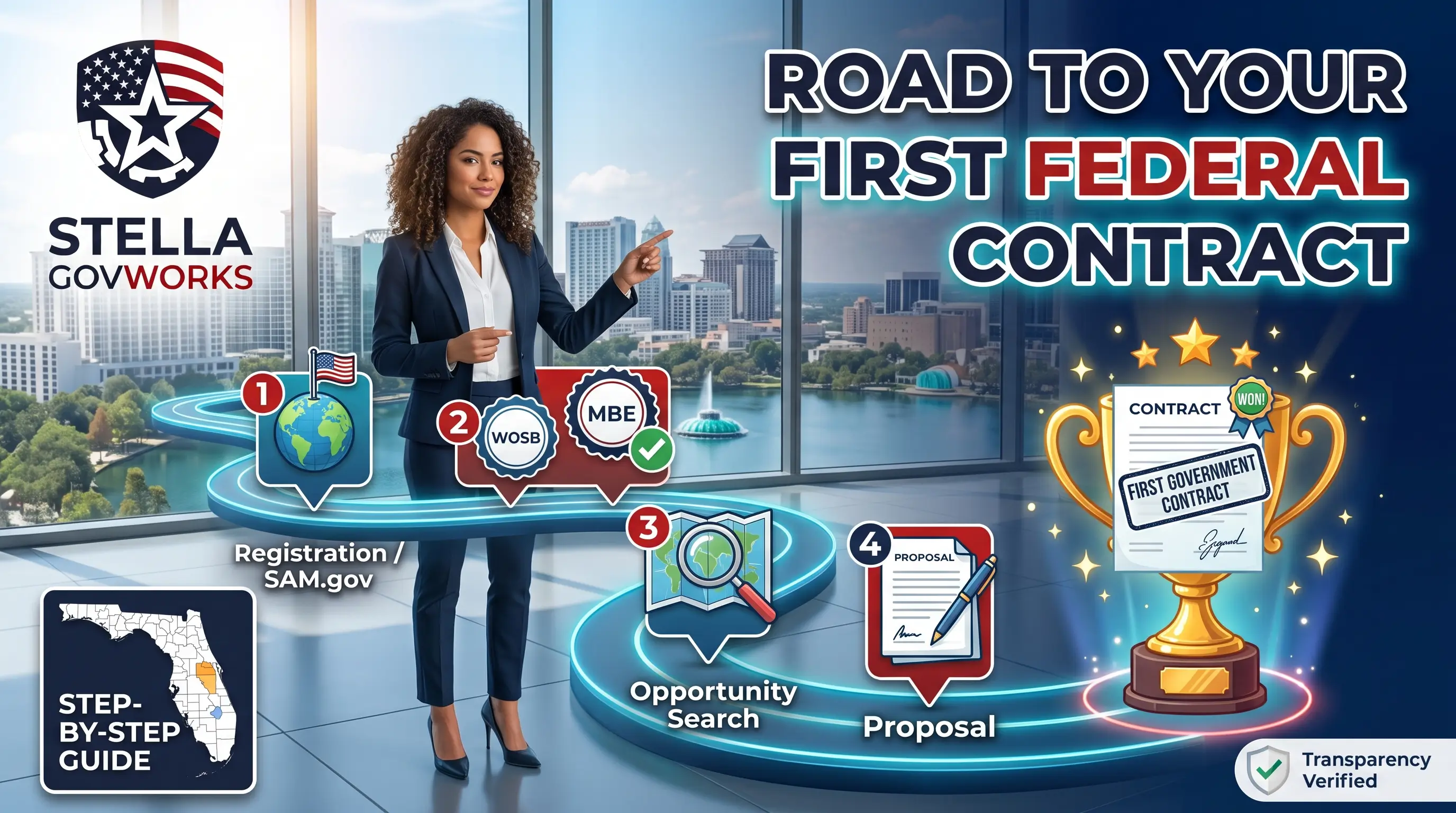
The United States government is, collectively, the largest buyer in the world. For a small business, that scale can sound out of reach, but the path to a first federal contract is more of an orderly process than a stroke of luck. This article brings together, in a single roadmap, the steps that make the difference between trying without direction and moving forward with strategy.
1. Basic compliance and registration
Before competing for any contract, a business needs to be formally incorporated, have its tax ID number (EIN), its Unique Entity ID (UEI), and an active registration on SAM.gov, the federal vendor system. Without this step, no agency can even consider a proposal, no matter how good the product or service is.
2. Identifying the right NAICS code and doing market research
Every good or service the government buys is classified under a NAICS code (North American Industry Classification System). Identifying the right code makes it possible to understand the real size of the market, who the frequent buyers are in that category, and which agencies have purchased similar services in the past.
Useful tools for this stage
Platforms like SAM.gov (for active opportunities) and USAspending.gov (for historical purchasing data) allow research into buying patterns by NAICS code and by agency, with no need for paid tools to get started.
3. Evaluating applicable certifications
Depending on the company’s ownership structure and location, certifications like MBE, WOSB, HUBZone, or 8(a) can open access to set-aside contracts with less competition. Not all of them apply to every business, but it’s worth evaluating them from the start of the process, not after several failed attempts in the open market.
4. Building a solid capability statement
This is the standard introduction document in this market: a one-page document summarizing the company’s experience, differentiators, NAICS codes, certifications, and contact information. It’s the first thing a buyer or a prime contractor reviews before considering a subcontracting relationship, and it’s often the document that opens or closes an initial conversation.
5. Starting with subcontracts or small contracts
Very few companies win a large federal contract as their first experience. The more realistic path is starting as a subcontractor to an already established prime contractor, or competing for small, local contracts that build past performance, one of the most heavily weighted evaluation criteria in later solicitations.
Why past performance matters so much
Federal agencies tend to prefer vendors with demonstrable experience, even on small contracts, over businesses with no documented history at all, even when the latter may have equal or superior technical capability. Building that history, even with modest contracts, is an investment that pays off in future opportunities.
6. Applying bid/no-bid criteria from day one
Even without prior experience, it’s better to evaluate each opportunity with judgment before investing time in a proposal, rather than competing for everything that becomes available. This avoids the wear and tear of chasing opportunities where the real chance of winning is low.
Common mistakes when attempting a first federal contract
The most frequent mistake is trying to compete for large, high-visibility contracts as a first experience, without having gone through registration, certifications, or small contracts that build credibility. The second common mistake is giving up after the first failed attempt, without adjusting strategy based on what was learned.
How much time this process realistically takes
From initial registration to the first award, the full process usually takes between six months and two years, depending on the industry, the certifications being pursued, and the discipline applied to pursuing opportunities. It isn’t an instant process, but it also doesn’t require years of passive waiting: every step along the path (registration, certifications, capability statement, first small proposals) builds measurable progress.
Prime contractor vs. subcontractor: where to enter first
A prime contractor is the company that signs directly with the agency and takes on full responsibility for execution. A subcontractor works under that prime, delivering a specific part of the work. For a company with no prior track record, entering as a subcontractor to an established prime is usually more accessible than competing directly for a full contract, because the prime has already gone through the qualification process and only needs to validate the subcontractor’s specific technical capability.
What a teaming agreement is
This is a formal agreement between two or more companies that decide to submit together for an opportunity, combining strengths (for example, one contributes certifications and the other contributes specific technical capability). It’s a common tool for small companies to compete for opportunities they couldn’t individually cover on their own.
Free resources to get started on this path
Beyond SAM.gov and USAspending.gov, there are no-cost resources that help at different stages of this journey: Procurement Technical Assistance Centers (PTACs), present in several states including Florida, offer free advisory support specifically focused on government contracting, and tend to be a good complement during the early stages of registration and opportunity research.
Common myths about federal contracts worth dropping
Myth: only large companies win federal contracts
In reality, the federal government has explicit goals for directing a significant share of its purchases to small businesses, precisely to keep the market from being concentrated only among large contractors. Small businesses that understand how to navigate the system (registration, certifications, small contracts first) have a real path to access.
Myth: you need to know someone inside the government to win a contract
Relationships help, but they aren’t a requirement. Agencies are legally required to evaluate proposals against criteria published in advance, and a company with no prior contacts can win if its proposal meets those criteria better than the competition.
Myth: the process is exactly the same for small and large contracts
It isn’t. Contracts below certain dollar thresholds tend to have simplified processes, with fewer documentation requirements and shorter timelines, which makes them considerably more accessible for a company new to this market.
A realistic view of the first year on this path
The first few months are usually spent on registration, market research, and evaluating certifications, with no proposal submitted yet. From roughly the third or fourth month, with the capability statement ready, it’s reasonable to start monitoring active opportunities and applying bid/no-bid criteria to the first candidates. The first proposals submitted, especially small contracts or subcontracting opportunities, serve both as an attempt to win and as a learning experience about the real evaluation process. Reaching a first award within the first year is a realistic outcome for a company that follows this path consistently, although the exact timeline varies by industry and the availability of opportunities in the company’s specific category.
Signs your company is ready for the next level
After winning one or two small or subcontracted contracts, a few signs indicate it’s time to pursue larger opportunities: documented, positive past performance, financial capacity to cover a larger contract’s cash flow before the first payments arrive, and a team capable of real execution without relying exclusively on the owner. Moving forward before having these three conditions in place tends to create the same problem as avoiding large contracts from the start: committing to something the company still can’t sustain.
The next step
None of these steps, on their own, is complicated. What usually goes wrong is the order: many companies try to compete for large contracts before having the registration, certifications, or track record needed. Your first federal contract is almost never the biggest one available: it’s the most achievable one with what your company already has today.
At StellaGovWorks, we support small businesses in Florida through every one of these stages: from registration and certifications, to identifying opportunities and preparing the proposal. If your company is considering taking the first step toward a federal contract, you can schedule a consultation with Stella to review where you currently stand and what the most realistic next step is for your case.
Frequently asked questions
It’s not required. Any small business properly registered on SAM.gov can compete for open contracts that aren’t set aside. Certifications broaden access, but they aren’t a requirement to participate.
Skipping small contracts and subcontracting to go straight for large opportunities, with no past performance to back up the proposal in front of evaluators.
Yes, it’s possible to do it independently, although the volume of registrations, terminology, and evaluation criteria leads many small businesses to prefer guidance during the early stages to avoid costly mistakes that delay the process.