


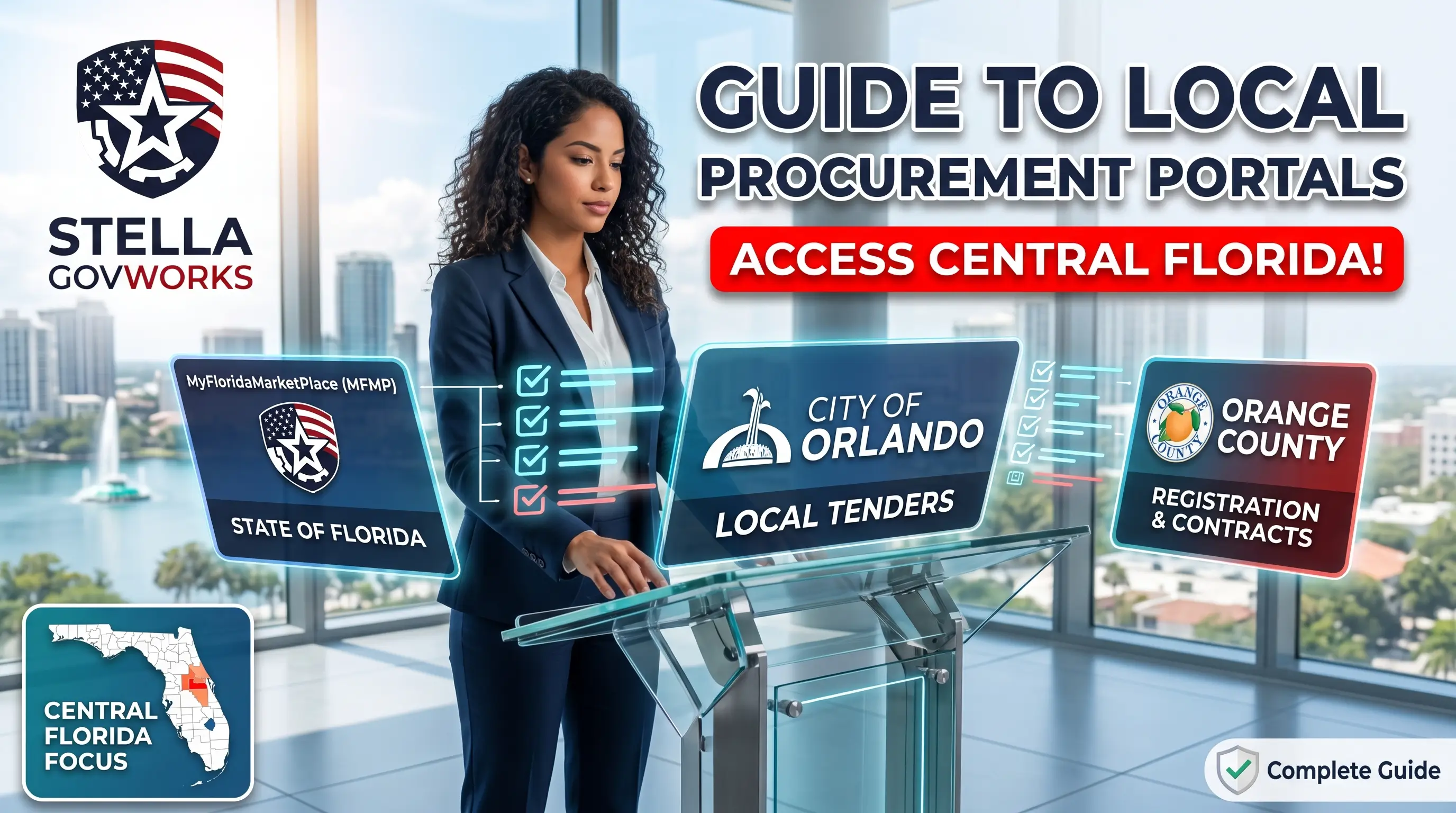
For a small business in Central Florida, there are three main entry points into the world of public procurement before even thinking about federal contracts: the state system, the City of Orlando’s portal, and the Orange County portal. Each has its own registration process, its own technology platform, and its own flow of opportunities, and being absent from one of them means literally missing out on those bids when they’re published.
MyFloridaMarketPlace (MFMP)
This is the State of Florida’s official electronic procurement system, connecting state agencies with over 80,000 registered vendors. Its reach covers state agencies, public universities, and other state entities, with opportunities in construction, technology, professional services, healthcare, and tourism, among other categories.
How to register
Registration happens at vendor.myfloridamarketplace.com and includes company information, federal tax ID (FEIN), primary contact details, and product or service category codes. After the basic registration, businesses must complete the Substitute W-9 form through the Florida Department of Financial Services portal.
Costs and benefits of registering
Registration itself is free, although transactions resulting from state contracts carry a 1% transaction fee. In exchange, the system provides 24/7 access to procurement opportunities, automatic notifications by category code, and access to certifications for women-, veteran-, and minority-owned businesses directly through the platform.
City of Orlando
The City of Orlando manages its procurement opportunities through its OpenGov electronic portal, where registration is also free. It’s an independent system from the state one, so registering on MFMP doesn’t automatically grant access to the city’s opportunities.
How to register and what to expect
By registering at procurement.opengov.com/portal/orlando, a business receives automatic notifications of opportunities based on the category codes (NIGP) it selects. The city’s Procurement and Contracts Division is also available for direct questions by phone if there’s any confusion about the process.
Orange County
Orange County uses its own e-procurement platform, through ProcureNow, for vendor registration. This too is a separate system from both the state one and the City of Orlando’s.
Registration and new-vendor welcome sessions
Registration happens at secure.procurenow.com/signup. In addition to registering, the county hosts monthly virtual new-vendor meetings, on the first Tuesday of every month between January and July, where businesses can introduce themselves directly to county buyers and learn firsthand how the award process works.
Why it’s worth registering on all three systems at once
Each portal gives access to a different flow of opportunities, with different buyers, categories, and dollar amounts. A small business that registers on only one of the three is, without realizing it, leaving out two-thirds of the local public procurement market it could access from day one.
What to do after registering
Registration is only the first step. It’s worth periodically checking active opportunities on each portal (not relying solely on automatic notifications, which sometimes fail or arrive late), and attending new-vendor sessions when available, since they’re one of the few chances to interact directly with the people who make purchasing decisions.
Key differences between the three systems
Although all three serve a similar function, they aren’t interchangeable. MFMP covers only state agencies and public universities, with a much larger volume of opportunities but also more competition. The City of Orlando and Orange County portals cover municipal and county purchases respectively, generally with smaller dollar amounts but also fewer registered competitors, which can represent a real advantage for a small business just starting to build a track record.
Understanding category codes (NIGP and similar)
Each platform uses a coding system to classify goods and services: the NIGP (National Institute of Governmental Purchasing) system is the most common at the local level in Florida. Selecting the right codes at registration is what determines which automatic notifications a business receives. Choosing codes too broadly generates excessive irrelevant notifications; choosing codes too narrowly can cause a business to miss related opportunities. The practical recommendation is to select between 5 and 10 codes that precisely cover the actual services the company offers.
What changes after winning your first local contract
Once a company wins its first award through any of these three systems, that contract becomes verifiable past performance, which can be cited in future proposals, whether local, state, or even federal. That’s why, even though the dollar amount of a first municipal or county contract may be modest, its strategic value as proof of capability is often greater than its immediate financial value.
Informal vs. formal purchases: where a new small business has the best shot
At the state, municipal, and county level alike, agencies typically split their purchases into categories by dollar amount: low-value informal purchases (which often only require one to three quotes, with no formal competitive process) and higher-value formal purchases (which require a complete invitation-to-bid or request-for-proposals process). For a small business with no prior track record, low-value informal purchases represent a more accessible entry point for building buyer relationships and past performance, before competing in larger, more contested formal processes.
Keeping your vendor profile updated as a competitive advantage
Many public buyers, especially at the municipal and county level, directly review registered vendor profiles when looking for informal quotes, even before publishing a formal solicitation. A complete profile, with a clear description of services, correctly selected categories, and up-to-date contact information, increases the odds of being contacted directly for this type of lower-competition opportunity.
What to do if a notice of opportunity arrives with short notice
It’s common for an automatic notification to arrive with a tight deadline. In those cases, the first step is to quickly apply bid/no-bid criteria (see the article dedicated to that matrix) to avoid investing time in an opportunity that couldn’t be properly executed with the available timeline anyway. If the initial evaluation is positive, contacting the buyer directly to confirm whether there’s flexibility on the date, or whether it’s a strict deadline with no exceptions, is a step many new businesses skip more out of unfamiliarity than lack of time.
Beyond Orlando and Orange County: expanding the search
Once a company has mastered registration and monitoring for these three systems, the same process can be replicated across neighboring Central Florida municipalities, such as Winter Park, Kissimmee, or Seminole County, each with its own vendor portal. Gradually expanding the geographic radius of registration, once the process is already familiar, multiplies the number of available opportunities without requiring proportionally more effort.
Keep a record of your completed registration
Once registration on each of the three systems is complete, it’s worth saving screenshots or email confirmations of the successful registration, along with the category codes selected. This documentation is useful not only as an administrative backup, but also because some certifications (such as MBE or WOSB) ask for evidence of active registration in public procurement systems as part of their own application process.
Frequently asked questions
No, registration on all three systems (MFMP, City of Orlando, and Orange County) is free. Only transactions resulting from state contracts carry a 1% administrative fee.
Each individual registration usually takes 30 to 60 minutes if the company already has its tax and contact information ready. Completing all three back to back is doable in a single work session.
Yes, it’s important to keep contact information and category codes updated on each platform, since an outdated registration can mean missing out on notifications for relevant opportunities.